
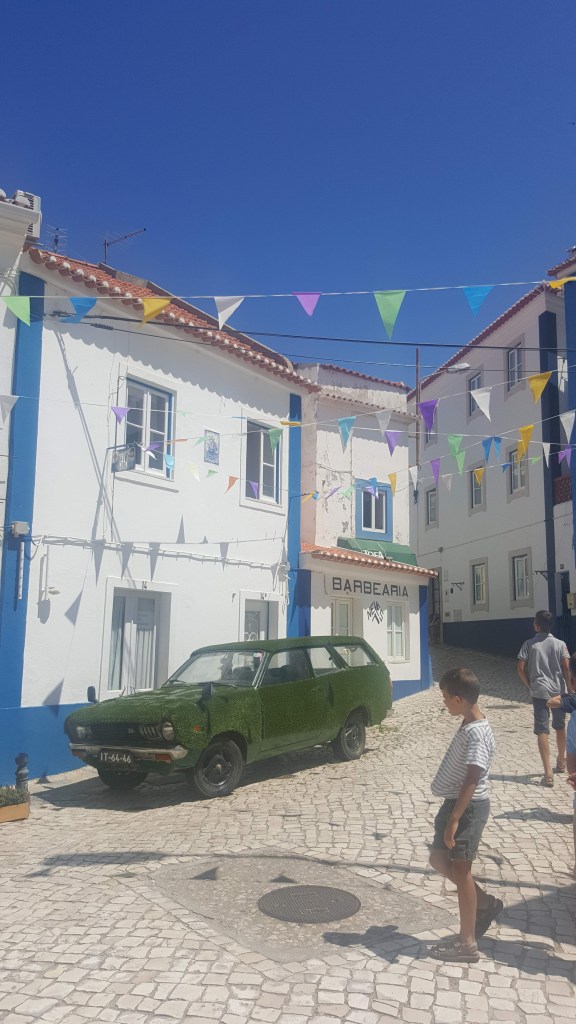
I’ve been thinking lately about how slow travel really helps me create a calm space in my mind while I travel, and how I remember cities more clearly when I haven’t rushed through them.
It makes sense, to a degree; when you slow down, and remove pressure to always be looking for the next thing, you create a space where observation is possible. The chance to notice the details of a city—how it smells and sounds, the musicality of a language you don’t understand, the colours in the clothing and details of the architecture—might all get missed if I spend my trip looking at my route on my phone, rushing from one place to the next.
I started to wonder if this was a preference, or if there was any science behind the link between slowing down while travelling and being able to recall details of my trip afterwards. And what I found surprised me—it turns out, there’s actually quite a lot of research on how speed disrupts memory-making, can cause problems with accuracy, and how we recall trips based on emotions.
So, how does slow travel help us better remember our trips?
Travel, by its nature, disrupts our internal “autopilot” when making memories
You know when you take the same route every day—to work, school, the gym, or anywhere else familiar—and when someone asks you about your commute, you can’t recall any of the details? This is colloquially referred to as “highway hypnosis”—the phenomenon where our brains recognise patterns so well that they don’t commit them to memory. What’s the point of needing to recall steps you take every day? Better to save that brain space for new information.
But when you’re travelling, all of that is off the table. Even if you’ve been to a location before, you won’t have taken a route so often that your brain squares it away under “not important”. If anything, our brains might take too much information in under the guise of “we might need this later”. Equal Psychology explains how our brain’s primary function is to keep us safe, and memory is a big part of that—our brains “save” information that might be useful later, leading to overwhelm.
I’ve had this experience a few times (and I’ll bet you have, too!): I’m in an airport somewhere I’m not familiar with. I’m looking for something specific—a taxi stand, or a bus terminal, for example. And nothing looks familiar, so I end up going over everything with my eyes—from sign to sign to sign, looking for something that looks like it might be helpful. Between deciphering where to go and trying to keep up with the flow of people moving through a terminal, it’s easy to get frustrated. This is because my subconscious brain doesn’t know what’s important, so it’s making the decision that everything is. This isn’t the right state to be making memories in!
In my experience, we remember things that make us feel or think.
Everyone processes new information differently, but in my experience, I remember most vividly the things that make me feel a certain way. I like rom-coms, but I remember scary movies better than most (as I find them grotesque and thrilling); when people ask about work, I’m able to recount my “wins” and “losses” far more easily than my everyday tasks; and my most detailed memories of friends and family are all tied to happy or heartbreaking moments.
This is anecdotal of course, but there’s research that backs it up: a 2020 Columbia University study found that strong memories often form during emotional episodes.
And travel can be full of emotional episodes! The joys and wonders of seeing somewhere new; the thrills of trying new things; the feeling of fear when you’re not sure you’re safe; the sadness that’s felt when friends are absent. All of these make travel an opportunity for memories to form as special moments spark deep feelings.
But how does slowing down help?
So we know that travel changes the way we form memories, and we know that because of the potential for deeper emotional experiences, travel is an ideal opportunity to create long-lasting memories. But that still doesn’t prove my theory that intentionally travelling slower will help make cities memorable; after all, with the above points in mind, surely speeding through cities isn’t a problem, right?
Well, yes and no. It’s true that you can have a memorable trip without slowing down; but if your goal is to create lasting memories, then going as fast as possible might be hurting your cause. The speed-accuracy tradeoff (sometimes referred to as the SAT) suggests that the faster we move, the less accurately we process information. If what you’re trying to do is immerse yourself fully somewhere new, and build strong memories about the place you’re in, speeding through it will be detrimental to your goal.
In this article by Psychology Today, the science of slowing down is explained: how pausing and taking your time “allows your senses to register colo[u]r, texture, and sound, which boosts mood-regulating neurotransmitters like serotonin and dopamine”. Put simply, slowing down not only lets you register details more clearly and easily, but also supports brain chemistry linked to positive mood.
So, how does slow travel help make cities memorable?
-It interrupts our usual “autopilot” mode
-It helps our brains to retain more information than usual
-It pushes us to create deep memories through emotional experiences
-It causes us to notice the details that make a city truly memorable
The finer details are what make cities special, and this is what I love about slow travel—rather than limiting what I can see, I see it as a way to open my eyes to the things around me I might miss if I didn’t pause and linger. It’s in these moments that cities stop feeling overwhelming, and start feeling memorable.
 No Small Wander