
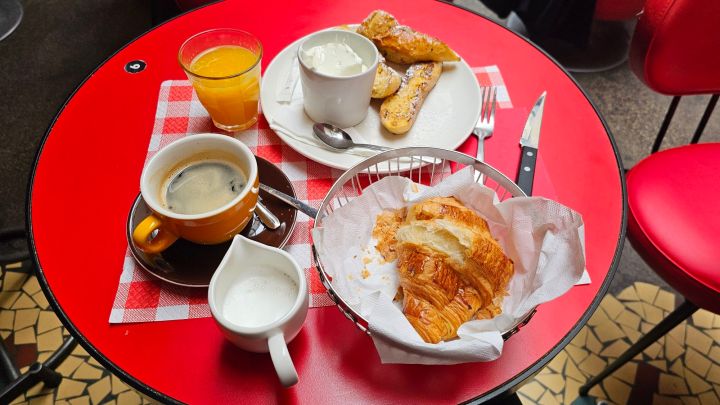
On Monday, I got back from a nine-day trip to Paris.
It was awesome—mostly. But the hotel I stayed in left a lot to be desired.
To be clear, I didn’t stay at the Four Seasons or the Plaza—I went to Booking.com, popped in the area I wanted to be in, and searched for something budget-friendly. I wasn’t expecting pillow mints or complimentary breakfasts.
So in the spirit of “you get what you pay for”, I feel conflicted about reviewing this hotel. Because my review wouldn’t be positive, but I feel it would be fair. The things I could complain about, but wouldn’t, include:
- Mold in the shower
- Mold on the bathroom pipes that had been painted over
- A TV with a cracked screen
- Graffiti on the furniture
- A “clean” white towel with bright blue toothpaste stains
…you get the idea.
But truthfully, none of that was stuff that bothered me. I’ve stayed in budget hotels and hostels, shabby-chic cottages, 5-star resorts, and tons of house rentals. There isn’t a lot that surprises me, or puts me off—at least not to the degree that I can’t shrug and get past it.
But all the little things aren’t the reasons I’d give a bad review. This hotel had practises that, as a solo female traveller, made me feel unsafe staying there. These included:
–The concierge loudly announcing my room number, within earshot of the entire lobby whenever I stopped by the desk with a request or a question (I don’t want strangers to know where to find me at night)
–My door getting stuck in the frame and needing my full weight behind it to open (I worried that if someone creepy followed me to my room, getting in quickly would prove challenging). It also meant that I couldn’t use my portable lock on the door, as it wouldn’t fit.
–The door itself had no peephole, so that when there were knocks, I could see who was there. It also didn’t have a physical hotel door lock on the bedroom door, only a digital one—so if someone had a key they’d get into the room without anything stopping them.
–No telephone in the room—meaning that if there was a problem, I had to travel down five floors. If I needed to call for help in an emergency, I guess I’d have to look up the number of the front desk on my smartphone.
-Three days I came back to the room and found that my door hadn’t been locked after housekeeping left.
All these things aren’t just small cosmetic trifles—these were things that made me feel like coming home to my room meant tapping into anxiety, because I didn’t feel safe. It meant that when I slept, I kept the chair close to the door, so I could make sure that if someone did open it, I would hear the chair scrape and be more likely to defend myself. And I was worried about that—at one point, I made awkward eye contact with a single man in the lobby that made me look elsewhere immediately. What if he followed me up to my room, or came by later?
I tried explaining this to the concierge in my (admittedly not perfect) French. The third time they asked for my room number, I told them, I don’t want it said out loud. Do you have a pen, so I can write it? He gave me a pen, and as soon as he had the paper in his hands, he exclaimed, “Ah! Room 530!”
I admit, I lost my cool. In my—again, broken—French, I told him that I had specifically didn’t say the room number out loud so that strangers wouldn’t know where I slept.
People in the lobby heard all of this, of course. But the man behind the counter couldn’t understand why this was an issue—until one of the lobby dwellers intervened and translated. It was awkward as hell, watching this kind stranger say “She’s worried about being attacked…by someone like me.” He then turned to me and explained that he and his wife were leaving that day, and hoped I wasn’t worried about my safety. I had to explain about the man from the night before.
Even then, I wasn’t sure if I was taken seriously. The concierge smiled the entire way through the experience—not a great sign that he understood this was a serious matter. From then on, I waited until the lobby was empty before I approached the front desk.
Another time, I came down to explain I’d found my room unlocked after a day out—a different concierge (one of four men I saw during my stay, which might be why there’s obliviousness to women’s safety) said he’d “make a note”. I told him again the following day, when it happened again. The most I got was another “note” in the system.
So that leaves me in a pickle, because frankly, I wouldn’t stay in this hotel again. But I also hate giving negative feedback. I’ve worked in hotels; it sucks when someone has a bad experience, and you know that they won’t be back, so you can’t change their mind.
I also don’t like to be negative. Anyone can have a bad day, and I certainly wouldn’t want to be judged based on a bad day at my job. I’d rather shout about things I love and shut up about things I hate—why put that negativity into the world?
In short: because I think it will help people.
Will it be uncomfortable to write? Yes. Will it be negative? Also, yes. Will I feel bad, because it’s possible that this is a hotel that’s run by a small team that can’t afford to upgrade their systems and appliances? Yes.
But also—I wish that I’d had the knowledge going into this experience that I had now. I wouldn’t have booked had I known. And if I can help someone else like me, I’d like to.
There’s also a small part of me that hopes that the hotel staff see my comments, and reconsider their practices of announcing names and being unbothered by unlocked rooms. But that, I have less hope for (especially since talking to them in person didn’t do much).
What would you do in my scenario—publish something publicly? Reach out privately? Let me know in the comments; and as always, happy travels!
 No Small Wander